Why is determining the composition of a kidney stone so important?
Kidney stone composition analysis
A kidney stone is not just a “stone” — it is a signal of metabolic disorders in the body. The European Association of Urology (EAU) guidelines clearly emphasize: determining the chemical composition of kidney stones is essential for proper treatment and prevention of recurrence.
Simply put — without composition analysis, treatment is incomplete
How to send a kidney stone?
Take the stone
Place the obtained kidney stone—whether it passed naturally or was removed with the help of a urologist—into a small container or plastic bag.
Add your contact details
Provide your first name, last name, personal identification number, and email address.
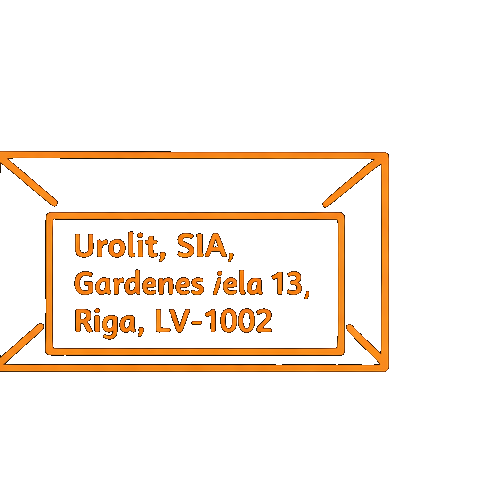
Place everything in an envelope
Write the address on the envelope: “Urolit, Ltd.”, Gardenes Street 13, Riga, LV-1002
A little patience
Your kidney stone spectrometric analysis will be completed within 5–8 working days.
Receive the results
You will be able to view your kidney stone composition results at www.datamed.lv
Book a consultation
Schedule an appointment with a urologist to receive a comprehensive assessment and a plan for дальнейшее treatment.
The EAU recommends:
to determine the composition of kidney stones in all patientsin whom a stone has been passed or surgically removed,
to analyze the stone againif stones form again,
use the analysis results to:
adjust the diet,
prescribe targeted medical prevention,
reduce the risk of kidney stone recurrence.
Important fact: Without prevention, kidney stones recur in up to 50% of patients within 5–10 years.
Imaging tests (ultrasound, CT) show:
the stone size,
the stone its location,
sometimes—its density.
They do not revealwhat the stone is made of
In contrast, composition analysis determines:
whether the stone is calcium oxalate,
uric acid stone,
infection-related (struvite) stone,
or rare metabolic disorders.
Each of them has completely different prevention.
Important fact: Without prevention, kidney stones recur in up to 50% of patients within 5–10 years.
The analysis provides answers to the following questions:
why the stone formed,
what the risk of recurrence is,
what specifically needs to be changed:
in the diet,
fluid intake,
medication.
This allows you to move from “general advice” to a precise, personalized plan.
The EAU guidelines particularly recommend analysis for patients who:
have recurring kidney stones,
the stone was larger than 5–7 mm,
surgery was required,
kidney stones appeared at a young age,
there is only one functioning kidney,
there is diabetes, gout, or intestinal disease,
there is impaired kidney function.
In practice — for most patients, this analysis is justified and recommended.